 "The Sirens ( Trois Sirènes) – Claudel, Reves & Chanel." -- an Art object in Dallas embodies a Feminine Artistic Legacy by Suza Kanon
Today's blog is about the sex lives of 3 different beautiful, intelligent women who were all deeply passionate about art & its legacy: Camille Claudel, Wendy Reves & Coco Chanel. Although though they may have never met during their lifetimes, the ladies all came together at the base of a staircase in a lush estate near the village of Roquebrune-Cap-Martin on the French Riviera. All three were lovely models, professionally involved in art; but where they differ is their financial & legal relationships with their lovers & family.
Really this story describes the adventures of a white marble sculpture inspired by a stunning female artist who wasn’t given the right to choose her own path or handle financial affairs. Certainly our society has come a long way from back then and more respect is given to the abilities of our females… or has it? Let’s look at the stories of the three sirens and you can decide for yourself.
i.

[[portrait of Chanel by Marie Laurencin (1923)]]
Coco (1883-1971) was a former singer and model better known as a artist/ fashion designer from France whose work is shown in art museums & worn by women across the globe. Chanel’s lover Bend’Or, the 2nd Duke of Westminster, asked her to marry him (he had recently left one of his many wives). Coco declined, but the Duke still built his mistress a villa on the French Riviera. She said ‘Everyone marries the Duke of Westminster. There are a lot of duchesses, but only one Coco Chanel." The couple continued seeing each other polyamorously for years alongside their other relationships.
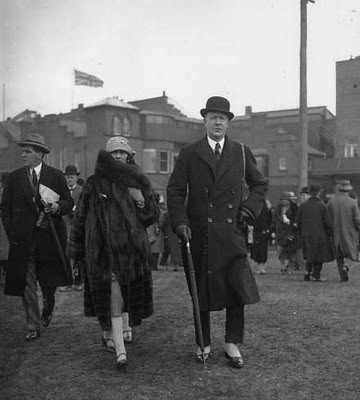
[[coco & bend’or]]
The Duke trusted Chanel to oversee the design of the La Pausa estate & gardens and work closely with the architect Robert Streitz during its construction during the late 1920's. [TUMBLR] Her desires were met and no one questioned her sanity regarding where she drew her inspirations or the legacy she chose to leave in this building. Coco after all is short for “coquette,” a French term for a kept woman.
Design elements were based on “the twelfth-century staircase and archways of Aubazine (the Catholic orphanage she grew up in which Chanel) sent her architect to view when he was designing her Riviera house of La Pausa” [Picardie]. She asked her Duke to build her a house that reminded her of her childhood and he did so with love.
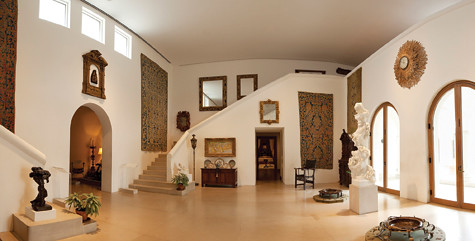
[[INTERIOR of La Pausa showing the Rodin sculpture at base of Staircase on the left]]
However she didn’t just take from her lovers, she also gave generously. Around 1920, she allowed one of her consorts to live in another of her other homes. Chanel allowed the Russian composer Igor Stravinsky to bring his wife & children to stay in her French country estate. The generosity was so that he might both escape the revolution in his home country & more importantly so that he might finish the composition of his symphony “the Rites of Spring.” Her patronage may have been erotically tinged, but she was a woman in a financial position to invest in his artistic legacy.
Coco maintained one of her many residences at the villa La Pausa and found romantic comfort in designer and illustrator Paul Iribe. He was engaged to her November 1933, but before they could be married, "he collapsed on the tennis court of La Pausa" from heart failure and died. [francetoday.com]
Chanel was never again engaged to be married after Paul, but to preparefor her autumn years she worked out an arrangement in 1954 with her old business nemesis, Pierre Wertheimer. He would maintain ownership of “Parfums Chanel.” In return, Wertheimer agreed to an unusual arrangement proposed by Chanel herself, attempting to revive her youthful years as the kept woman of wealthy men. Wertheimer would pay for all of Coco’s expenses from the large to the trivial for as long as she lived. [Mazzeo]
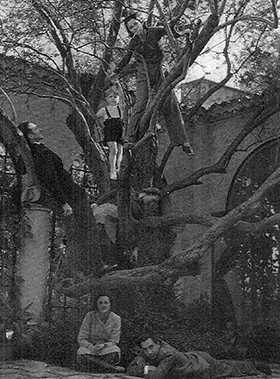
[[Chanel in a TREE at La Pausa]]
It should be remembered that Coco is the designer that popularized women wearing pants, and is also known for spending as she saw fit until she died. As for Coco’s long time lover the Duke of Westminster who financed the building of La Pausa, the notorious playboy got married several more times by the time of his death in 1953. During his life, he made sure his beautiful lover was safe and well cared for. Still she was a kept woman & the property at La Pausa did not belong to her.
Coco’s lover/benefactor died leaving her to survive on her talent and the good graces of friends & family.
After the Duke’s death, the villa had been sold to a couple named Wendy & Emery Reves. Here is where we find our real story taking place at La Pausa on this 'stage' built by Chanel, where a very special piece of art would come to live for a time.
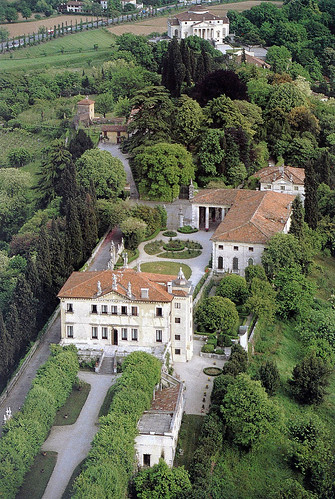
[[EXTERIOR of Villa La Pausa at Roquebrune]]
ii.
Lets take a moment to introduce you to the sculpture that inspired this entire research project, “The Sirens.”
At the bottom of this staircase inspired by a woman’s childhood sits a pedestal. It is the smooth, white sculpture showing Rodin’s most talented female model and protege. It draws the eye of all who pass up the nearby steps. According to an archivist from the Dallas Museum of Art where the work is housed, the marble sculpture was owned by the couple before their move into Coco’s villa on the French Riviera.
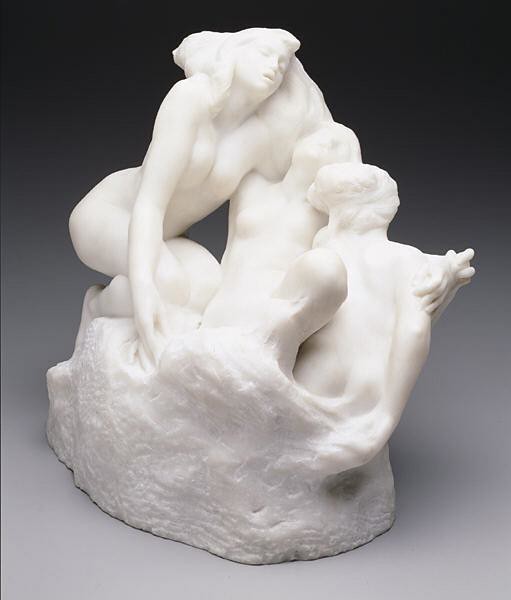
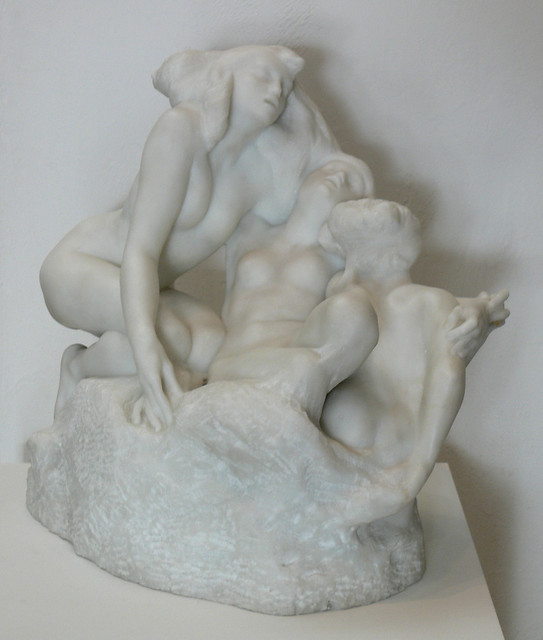 The Sirens (Trois Sirènes) 17 x 17 1/2 x 12 in (c. 1888) by Auguste Rodin featuring model Camille Claudel (in the holdings of the Dallas Museum of Art, Texas)
The sculpture is made of sparkling milky white crystalline marble, polished smooth. Its small size is barely over a foot and tall and wide, sitting perched on its pedestal awaiting inspection at the base of the stairs. The face of a woman seems to stretch up for a breath of air, drawing it in ecstatically. She arises from an entanglement of the sea, and the Sapphic energy of two other women.
Some myths interpret sirens as a trio of singing gorgons, human-like in their sexuality but monstrous in their destructive powers of persuasion. Sisters known for seducing sailors and inciting them to crash their vessels into the rocks, so that they might cling & drag the weaker men to a watery death. The sculptor Rodin gives his three dimensional interpretation of sirens distinctly gorgeous physical bodies, free of fins or feathers.
The fluid tactile quality of the stone used in the sculpture mimics the waves enveloping the female forms. The moment captured by the artist exudes sensuality. Are the women swimming in water or their own orgasmic climax?
In a way, the sculpture was returning to the village of Roquebrune with Reves. The artist Auguste Rodin had been known to holiday in the village during the time of his affair with fellow sculptor, Camille Claudel. Her form had inspired the body of the siren, his passion for her evident in the permanency of stone. Over 60 years after the sculpture’s creation, the model for this siren had returned to the village by the sea in marble form.
iii.
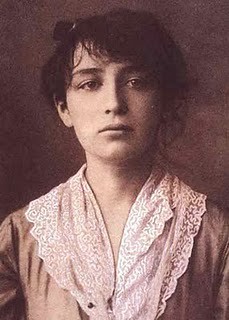
Camille (1864–1943) was a model for the masterwork in marble by Rodin “The Sirens” shown above in addition to several of his other works. More impressively, Camille Claudel herself attended art academy in a time around 1881 when most schools would not accept women. She learned & worked in the studios of Alfred Boucher & Auguste Rodin. Her own marble sculptures were expressively detailed and showed the influence of her teachers, now translated by her feminine hands into sculptures created from the universal hardness of the same marble. Claudel’s sculptural work was exhibited in galleries, salons and collected.
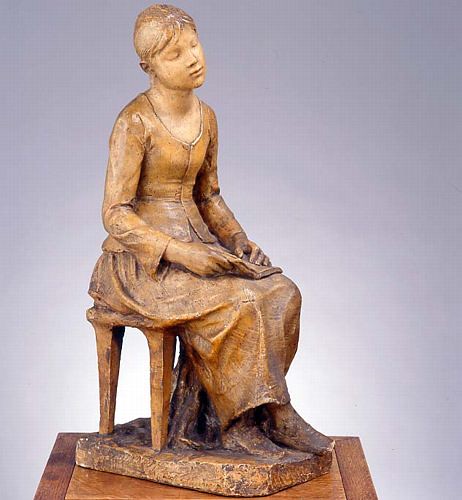
[[Camille as seen by her teacher Boucher, estimated age 19]]
(In 1885) “Rodin asked Claudel to become a studio assistant. By working as Rodin's apprentice, Claudel had the chance to study the nude figure, an unusual opportunity for a woman in the 19th century, but one that gave the artist a profound understanding of anatomical nuances. Claudel modeled hands and feet for Rodin's Burghers of Calais and posed for figures in his Gates of Hell.” [mistressesoftheuniverse.blogspot.com]
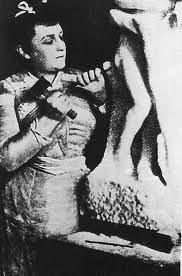
[[Claudel in the WORKSHOP]]
After Rodin began sleeping with his female student, he recreated Camille’s young nude body in his sculpture. If this marble sculpture was created before 1888, the model would have been 24 and her teacher 48.
“Rodin engaged the carver Jean Escoula to begin a marble version (1887), in which the group was to enlarged to a height of just over 17 inches.” [Christies.com] The sculpted artwork began its own existence and went on the road travelling across the world.
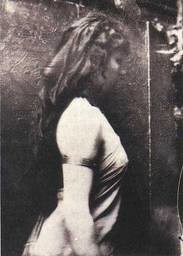
[[Claudel in PROFILE]]
“As an independent work (it was) shown at the 1889 Rodin-Monet exhibition (at Galerie Georges Petit, Paris)… The group is (now) known in different sizes and materials: marble versions are (currently) exhibited in the Montreal Museum of Fine Arts, The Cleveland Museum, the Ny Carlsberg Glyptotek, Copenhagen, Denmark and in the Thiel Gallery, Djurgarden, Stockholm” [rodin-web.org]
Let us not forget there is also a marble version of “The Sirens” in the Reves Collection at the Dallas Museum of Art. But the sculpture’s tumultuous path hasn’t taken it to Texas yet in this part of the story, we’ll get there later.
"The Sirens" was first exhibited as "Niobe" before becoming "The Three Sirens" in 1900. In the catalogue for that year's immense Rodin exhibition (at the Paris World Exhibition), they were related to a more recent love-death concoction, the Rhine maidens of Richard Wagner's operas… At least five marble versions survive, all created by studio assistants in Rodin's … atelier” [dallasmuseumofart.org]
“In 1914 the artwork could have been shown in San Francisco. It also could be the fourth marble mentioned in The Bronzes of Rodin: Catalogue of Works in the Musée Rodin II by Antoinette le Normand-Romain.” [email from DMA curatorial archivist MacLeod]
The sculpture had gone through much traveling before it came to La Pausa with the Reves. This sculpture’s creation started as a study for the larger Rodin work, “The Gates of Hell” and in the process eroded the innocence of the little known female artist, leading to events that put her very sanity in question.
“The Gates of Hell, a monumental portal covered with sculptural relief (standing at almost 20 feet tall), was Rodin's first commission from the French government.” [VIncent]
“Rodin conceived Trois Sirènes, like many of his finest multi-figure groupings, for The Gates of Hell, where the three entwined women appear half-way up on the left-hand door... Rodin is reputed to have written "The sea is the source of music." To which his patron Dr. Max Linde later replied, "Three sounds are needed to make a chord, so he represented the sounds by the three forms of intertwined women surging out of the sea’” [Christies.com]
“As he imagined these women, they represent ‘three powerful forms moving like a wave which has thrown them at the hero's feet, sisters--through the momentum and the rhythm--to the Rhine [Maidens], murmuring the songs of the world which he will transcribe in his verse. An admirable allusion drawn from the very heart of nature!’ [Normand-Romain]
Such critical accolades for the work of the artist were inspired by his model. Could Rodin have created this work without the inspiration of Camille Claudel? Is it possible to for a woman to be redeemed at in her second life as a work of art?
The sculpture carried on, but the model Camille Claudel’s ten year affair with the married artist twenty years her senior “ended unhappily in 1893, in part owing to Rodin's reluctance to abandon his lifelong companion Rose Beuret.” [Vincent]
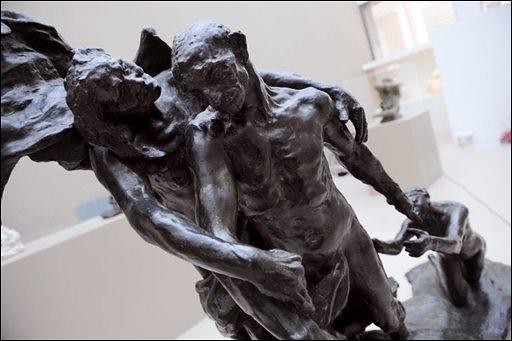
[[detail of CLAUDEL's sculpture, AGE of MATURITY]]
Camille Claudel began to feel public opinion had turned on her work. Several of her exhibits were censored or shut down entirely for their unclothed depictions of the human form. Finally, she had a melt down and destroyed most her own artwork. She may have felt isolated and persecuted being the rare female artist in a male dominated field. Her lover and mentor had refused to leave his wife & she overreacted. Camille had a punk rock moment and needed to break something for cathartic reasons (only 90 pieces are still known to exist today). Her family became concerned. In her day, a woman’s legal affairs & finances could be controlled by older male relatives.
“In 1893, because Rodin's work and stature occupied front stage in French culture, Claudel secluded herself in her studio to disassociate herself from him and to try to establish her own reputation. Her love for portraying the human form resulted in certain sculptures that the state and an infuriated press censored as overly sensual and inappropriate for public display.” [mistressesoftheuniverse.blogspot.com]
“After 1905 Claudel appeared to be mentally ill. She destroyed many of her statues, disappeared for long periods of time, and exhibited signs of paranoia and was diagnosed as having schizophrenia. She accused Rodin of stealing her ideas and of leading a conspiracy to kill her. After the wedding of her brother (who had supported her until then) in 1906 and his return to China, she lived secluded in her workshop.
Her father, who approved of her career choice, tried to help her and supported her financially. When he died on 2 March 1913, Claudel was not informed of his death. On 10 March 1913 at the initiative of her brother, she was admitted to the psychiatric hospital [a WEEK after the death of her father, 20 years after her break up with Rodin] ... The form read that she had been "voluntarily" committed, although her admission was only signed by a doctor and her brother. There are records to show that while she did have mental outbursts, she was clear-headed while working on her art…
For a while, the press accused her family of committing a sculptor of genius. Her mother forbade her to receive mail from anyone other than her brother. The hospital staff regularly proposed to her family that Claudel be released, but her mother adamantly refused each time. On 1 June 1920, physician Dr. Brunet sent a letter advising her mother to try to reintegrate her daughter into the family environment. Nothing came of this.
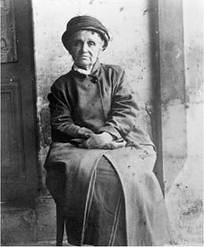
[[CLAUDEL in the ASYLUM]]
Paul Claudel visited her every few years, though he referred to her in the past tense. In 1929 Jessie Lipscomb visited her and insisted "it was not true" that Claudel was insane. [16 years after Camille had been committed] Rodin's friend, Mathias Morhardt, insisted that Paul was a "simpleton" who had "shut away" his sister of genius.
Camille Claudel died on 19 October 1943, after having lived 30 years in the asylum at Montfavet … and without a visit from her mother or sister (her mother died 1929). Her body was interred in the cemetery of Monfavet. No one from the family attended the ceremony (only a few members from the hospital staff). Later her remains were buried in a communal grave (the body was never claimed by her family)” [wiki/Camille_Claudel]
Rodin died in 1917 just four years after her commitment, two decades after their breakup. He had helped cultivate Claudel’s talent, but didn’t prioritize supporting her in the manner to which she was accustomed. Before his death he wrote “to his friend Morhardt in 1914 when the (Rodin) museum project was taking shape : “The idea of including some sculptures by Mlle Say [a phonetic pseudonym for Camille Claudel, Mademoiselle C., based on the French pronunciation of “c”] would please me very much. This house is quite small and I don’t know how the rooms will be arranged. There could be a few buildings for her and for me.” (www.musee-rodin.fr) The Paris museum now exhibits the largest grouping of her sculptures with a mere 15 pieces.
When Camille’s father/benefactor died it left her to survive on her talent and the good graces of friends & family.
But no grace was given to this artist by her remaining family. They committed her a week after the death of her father, kept her in an institution for 30 years and didn’t even claim her body when she passed away. A monument to Claudel can be seen today in the cemetery at Montfavet placed by fans of her work in honor of the female sculptor years after her death. Her real legacy to women of today lies in her talent.
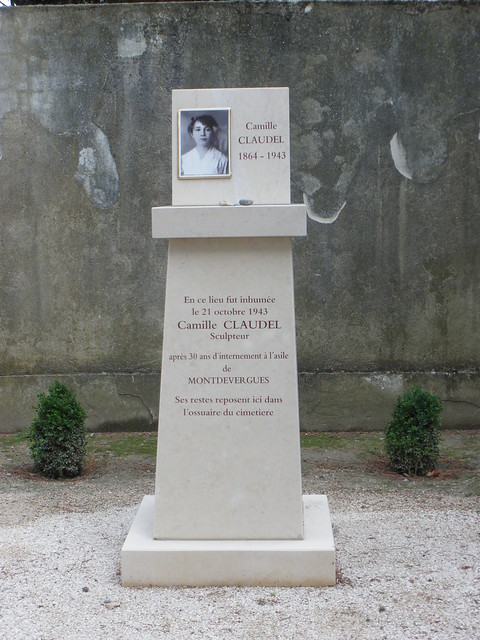
[[MONUMENT]]
There can be redemption through artwork and the legacy it leaves after the makers & muses have all gone from this life. So, we return to La Pausa in 1953, after the sculpture has been collected by Emery & Wendy Reves who have moved with their artwork into the house built for Chanel by her lover.
Finally, the three women come together at the bottom of the La Pausa’s stairs; all muses: model, artist & collector. Camille, Coco & Wendy: all necessary components to manifest this culmination.
iv.
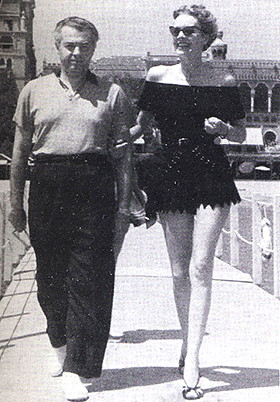
[YOUNG WENDY & EMERY]
Wendy (1916 - 2007) was a former New York fashion model who graced the pages of Vogue & Harpers Bazaar. She was born in Texas and her 3rd marriage was to a politically minded literary agent with a love for impressionism. Her Hungarian husband Emery Reves had collected & brokered art before their marriage; but in their decades together as a couple, their art holdings continued to grow. The Reves hosted Sir Winston Churchill for months at the villa, where he painted watercolors of the gardens and worked on his formidable four volume "History of the English Speaking Peoples." Churchill’s publishing was brokered by Emery, who had written the book “Anatomy of Peace” himself. La Pausa was filled with Wendy’s Southern hospitality and decorated with an enviable collection of works by masters such as Van Gogh, Degas, Cassatt & that delightful Rodin.
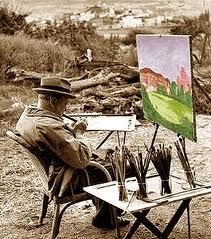
[CHURCHILL at La Pausa]
"Emery Reves, a Hungarian-born British citizen who lived in France and Switzerland, a…man at home in nine languages and at ease in the corridors of power… Still, when he died … his name was probably familiar to no more than a few thousand people and his passing escaped the notice of most of the world's obituary pages.
Wendy Russell Reves says she went home from the hospital the night of his death on September 5, 1981, and offered a vow to her husband's departed spirit. “You never did get the acclaim that you should have … I can't give you that, but I can make you the greatest collector of this century.'" [Smithsonian Magazine]
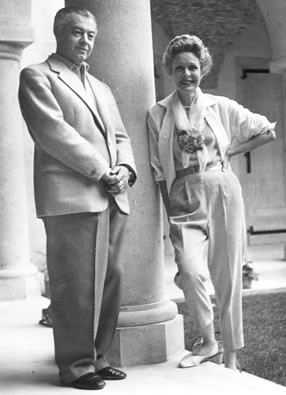
[OLDER WENDY & EMERY]
Wendy’s lover/benefactor had died leaving her to survive on her talent & the good graces of friends & family. By 1985 the Reves Collection was in Texas, but it didn’t happen quickly since first came the planning and extensive negotiations.
In Wendy's obituary in the London Tribune it mentions her three marriages, career as a couture model, friendship with Churchill, and her impressive philanthropic vision. It mentions she had a child with her first husband and very abruptly does not mention his name. Turns out Wendy left her only offspring Arnold Leon Schroeder a mere half a million dollars in her will.
The rest of the assets in her husband's non-profit foundations were directed to the missions they had been established for during his lifetime, such as international studies and art. He had wanted the work to be seen with the backdrop of La Pausa & this was done in a conceptual way similar to the Lehman replica built in a wing of the Metropolitan Museum in 1978.
Wendy understood that art can be more valuable when it is kept together as a unique curation and not parceled off. In fact, the stipulations for the Dallas Museum of Art to take control of the art collection were formidable. No piece in the collection could be loaned out to other institutions (commonly practiced to foster good will), nor could work be exhibited separately from the others. A replica of Villa La Pausa had to be incorporated into the construction of a wing in the city's new art museum. The museum complied, Wendy's fundraising challenges & deadlines were met, contracts were signed, a $25M city bond election was passed to raise funds for the construction of the replica of the Chanel inspired home, customs documents were filed, the artwork was catalogued, delicately wrapped and crated to be sent from Paris to Dallas, Texas in 1983. [Hartman]
The French Government refused to allow "so many valuable works of art out of the country without extracting a price." At first France asked for three of the major paintings valued at $1.2M before they would approve the export. "The museum refused, countering with an offer of the proceeds from a Manet" which the government declined.
By 1984, "Mrs. Reves sent word to the president's palace that she would cause an international scene if her collection was not released. Irvin Levy remembers her threatening to burn everything in it rather than let the French have it." [Hartman 196] Wendy and her lawyers were adamant that her philanthropic donation be respected. An emotional “outburst” of this sort would have been frowned upon if this had happened one hundred years prior.
In the end, the tribute to the French government necessary to get the Reves Collection exported from Paris to Dallas that was finally agreed upon required Mrs. Reves to give France $750,000 toward the purchase of a Bonnard painting they wanted and additionally pay them $250,000 in taxes. The City of Dallas had spent nearly $6 million by the time the Reves Collection wing opened in November 1985 at the Dallas Museum of Art. [Hartman]
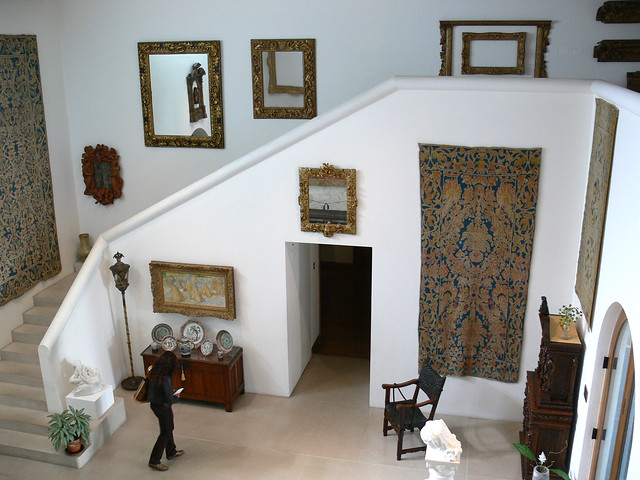
Wendy's gift to the public of the collection was not impulsive but well thought out over a long period of time. Her gift didn't make her husband the greatest collector of the 20th century as forecasted, but it is terribly romantic that she tried. Her significant donation of the fabulous collection was valued "equaled (to) that of everything the Dallas museum had bought or been given in its first 75 years." [Hartman 190] Instead of choosing to gift the Metropolitan Museum in New York (where a $30 million collection is less spectacular), Mrs. Reves chose to make a deeper impact in an urban area closer to her childhood home in Texas
Again, a woman's nostalgia for her youth creates an artistic legacy.
v.
The estranged son of Mrs. Reves filed a federal lawsuit this month attempting to dismantle the art collection and steal it from public view. As stated by the museum that houses the Reves Collection, “On behalf of the citizens of Dallas as well as the public at large, who are the ultimate beneficiaries of donations from the Emery Reves trusts, the Dallas Museum of Art not only has a legal responsibility to stand up to these unfounded claims, but a moral one, as well…
Mr. Schroeder… is hoping that French “forced heirship” laws will be applied to Wendy Reves’s estate, thus entitling him to one-half of her assets, rather than the $500,000 left to him in her will. This lawsuit further contends that Wendy Reves’s estate should include not only the personal assets inherited from her husband but also the Reves Collection and other assets of her husband’s charitable trusts - assets and artwork that were acquired by Emery Reves mostly before he and Wendy married and that were placed into charitable trusts by him. The suit argues that these gifts should be taken back in order that Mr. Schroeder can lay claim to them for his personal benefit.
Following the death of Emery Reves, Mrs. Reves (Wendy) acted as president of the charitable trusts and foundations established by him, which included overseeing the Reves Collection. She was therefore responsible for the donations of money and art made by his trusts, but she (Wendy) did not own their assets. These trusts and foundations were never part of Mrs. Reves’s estate, and the current lawsuit seeking to claim their assets is clearly without merit. Mrs. Reves entrusted the Reves Collection to the Dallas Museum of Art nearly 30 years ago, and the courts should ensure that Mrs. Reves’s generous wishes of public benefit, rather than Mr. Schroeder’s desires for private gain, are respected.” [Simek]
In the suit from last month, her son alleges that no taxes were paid to France (although a specific dollar amount was named in 1985 in Texas Monthly article). He names a handful of defendants from the art museum and UT-Southwestern (known for world class medical research). It also says the works were sent in plain unmarked boxes, which also counters what was reported twenty years ago in that story’s extensive description of the documenting placement from the villa, careful packing, & detailed labeling process that was overseen by Wendy & the museum’s staff (McCue) If her son was so terribly concerned with the alleged exploitation of his mother, he should have developed a relationship with her in the last twenty years of her life following the donation of the collection to the museum or earlier. It seems distasteful that it is easier for him to take up the matter with the courts, rather than confront his own mother while she was alive.
The collection was reportedly valued at $30M in 1985. In today’s market, it is estimated to be worth $400M (especially since the collection has received so much academic attention since put into public view twenty five years ago).
Wendy had her son at age 18 after marrying a year before. When he was 5, she began her career in New York as a fashion model. A year later she married her band leader second husband there. By 1948 she became romantically involved with Emery Reves, but they didn’t marry till 1964 in Switzerland when her son was thirty years old. (wiki Wendy Reves) "She had had enough of the institution and finally accepted one of Emery's frequent proposals only after their lawyers informed her that when he died she might lose control of the art."
Emery Reves described his wife as "a woman with a brilliant mind and imagination, tempered by much common sense. She is a woman who never bored me". [museumstuff.com]
Children are not entitled to a financial inheritance, only a genetic legacy. This is true for descendants of patrons, be they Medici or Reves. The value of intangible gifts like beauty, knowledge, creativity & common sense is not something that can be priced.
The descendents of Andrew Carnegie didn’t come to suggest the philanthropist was exploited by librarians. To misunderstand patronage as senility would have prevented much creativity & innovation in centuries past. Da Vinci was patronized by the pope, Botticelli by Medici, and Stravinsky by Chanel. More recently, photographer Banier was financed by Liliane Bettencourt of the Loreal fortune. [Vanity Fair] This did not please her natural children and with their greed’s litigation they unknowingly inherited tax scandals galore that had been previously tucked away.
Patronage of the Russian painter, Leo Michelson by Wendy Reves is not mentioned in her son’s recent lawsuit, only her charitable donations to major institutions such as municipal art museums and medical research facilities. Poor Camille Claudel lost the support of her family and their patronage of her art career and she ended up in an unmarked grave. Claudel’s tragic ending happened long ago and perhaps something can be learned from it.
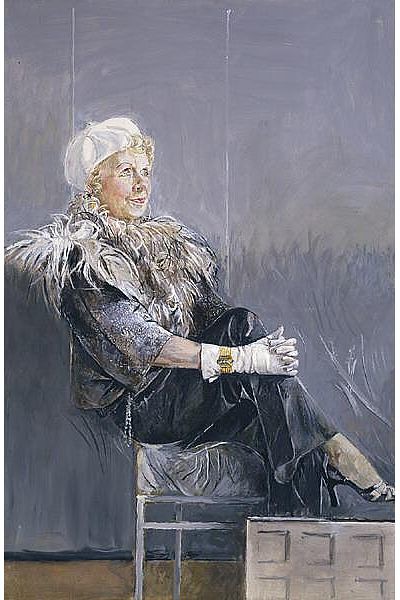
[Wendy Reves painted by Graham Sutherland in 1978]
Modern women are allowed to vote, wear pants, own property and choose our own paths. It is unbelievably short-sighted of Arnold Schroeder to undermine his mother’s choice to permanently share the art in the Reves collection with the public in the manner of her choosing.
Women should not be asked to justify our passions, nor should any other muse. Passion is how legacy is established.
===
BIBLIOGRAPHY
(A)Print sources -followed by- (B) sources only available via internet –ending with gratitude to all the contributors to the links below, the Dallas Museum of Art and my three historical sirens.
A.
Bond Rafferty, Jean. “Chanel N˚31” in France Today magazine October 2, 2009
magazine October 2, 2009
http://www.francetoday.com/articles/2009/10/02/chanel-n-31.html
Colacello, Bob. “The Bettencourt Affair, pt 1 Dangerous Liasions” in Vanity Fair  magazine November 2010 http://www.vanityfair.com/society/features/2010/11/bettencourt-part-2-201011?currentPage=1
magazine November 2010 http://www.vanityfair.com/society/features/2010/11/bettencourt-part-2-201011?currentPage=1
Dudar, Helen. “ An art-filled villa finds a special setting in Texas -Wendy and Emery Reves, Villa La Pausa.” Smithsonian (January 01, 1987) http://www.accessmylibrary.com/coms2/summary_0286-5452037_ITM
(January 01, 1987) http://www.accessmylibrary.com/coms2/summary_0286-5452037_ITM
Hartman, Thomas. "Have I got a collection for you." Texas Monthly magazine (November 1985) p. 188-196
magazine (November 1985) p. 188-196
Normand-Romain, Antoinette. The Bronzes of Rodin : Catalogue of Works in the Musée Rodin Volume II , Ashgate publishers (2007), p. 655.
: Catalogue of Works in the Musée Rodin Volume II , Ashgate publishers (2007), p. 655.
Simek, Peter. "Reves Heir Alleges Dallas Museum of Art Conspired To Acquire Art Collection (Updated)" in D Magazine . Posted online March 15, 2011
. Posted online March 15, 2011
http://frontrow.dmagazine.com/2011/03/reves-heir-alleges-dallas-museum-of-art-conspired-to-acquire-massive-art-collection/
Sancton, Tom. “The Bettencourt Affair, pt 2 The Gilded Friendship” in Vanity Fair magazine November 2010 http://www.vanityfair.com/society/features/2010/11/bettencourt-201011?currentPage=1
Mazzeo, Tilar J. The Secret of Chanel No. 5 . HarperCollins (2010). p. 95.
. HarperCollins (2010). p. 95.
McCue, Dan. “Heir Claims Dallas Art Museum & Trustees Carried Off Mom's $400 Million Collection” Courthouse News. Posted online March 15, 2011
http://www.courthousenews.com/2011/03/15/34941.htm
Picardie, Justine. Coco Chanel: The Legend and the Life . Harper Collins (2010)
. Harper Collins (2010)
Vincent, Clare. "Auguste Rodin (1840–1917) | Thematic Essay | Heilbrunn Timeline of Art History | The Metropolitan Museum of Art" found at: http://www.metmuseum.org/toah/hd/rodn/hd_rodn.htm
Wilonsky, Robert. "Wendy Reves's sole heir files Federal Suit to Retrieve Mother's Art Collection (left to DMA) & Money (given to UT Southwestern)..." in Dallas Observer posted online March 14, 2011.
http://blogs.dallasobserver.com/unfairpark/2011/03/wendy_revess_sole_heir_wants_m.php
B.
Dallas Museum of Art - Wendy & Emery Reves Collection (2 links - first about Reves, 2nd about the sculpture of Claudel. )
http://www.dallasmuseumofart.org/PressRoom/dma_339879
http://dallasmuseumofart.org:8080/emuseum/view/objects/asitem/3370/121/title-asc;jsessionid=FE10FBB63C24BAE929038822C0F5EC24?t:state:flow=7c481880-c00b-4d60-9c76-413d1727d55d
Reves Center for International Studies at the College of William & Mary in Williamsburg, VA. http://www.wm.edu/offices/revescenter/?svr=web
http://www.christies.com/LotFinder/lot_details.aspx?intObjectID=5258535
http://la-pausa.tumblr.com/about
http://mistressesoftheuniverse.blogspot.com/2009_05_01_archive.html
http://www.musee-rodin.fr/claud-e.htm
http://www.museumstuff.com/learn/topics/Wendy_Russell_Reves::sub::Emery_Reves
http://www.telegraph.co.uk/news/obituaries/1545653/Wendy-Reves.html
http://www.winstonchurchill.org/support/the-churchill-centre/publications/chartwell-bulletin/2010/30-dec-2010/1031-churchill-and-reves-a-breach-in-friendship
http://en.wikipedia.org/wiki/The_Gates_of_Hell
wiki coco chanel
wiki camille claudel
wiki wendy reves
wiki auguste rodin
wiki igor stravinsky
wiki emery reves
there is a movie about camille & a zillion or so about coco (but you really ought to read more)
[Immense gratitude from this writer to Martha MacLeod, curatorial administrative assistant with the European & American Art Department at the Dallas Museum of Art for exchanging emails with me about the provenance of this sculpture based on information in their archival holdings from “The Wendy & Emery Reves Papers.” Please note this blog was written without the consent or review of the DMA]